
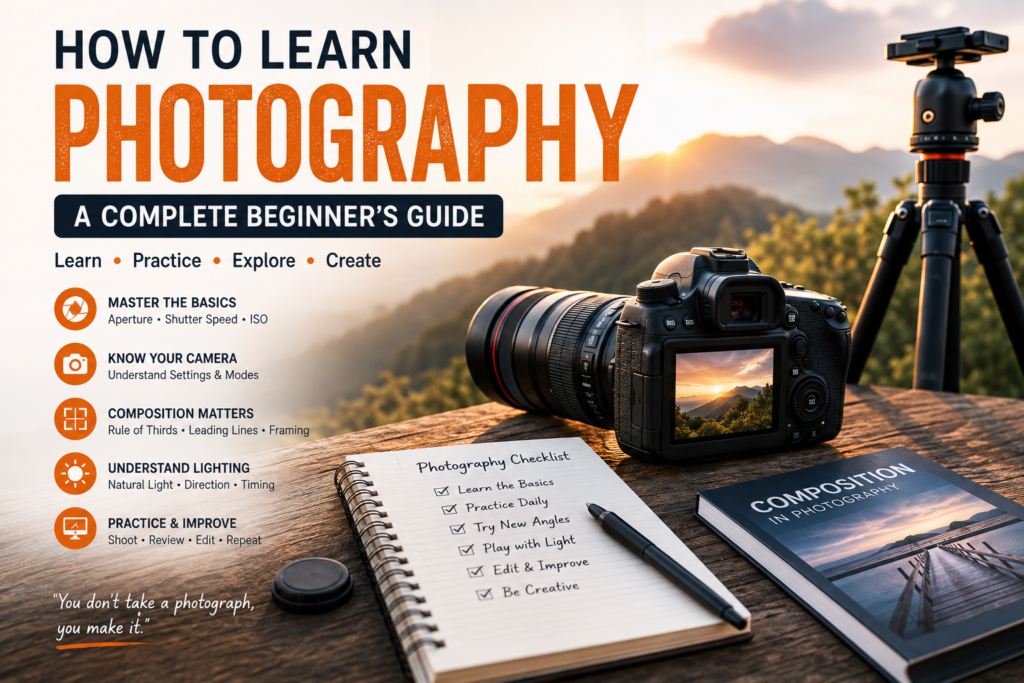
Photography is a creative skill that lets you capture emotions, people, places, and everyday moments through professional photography in a meaningful way. If you are wondering how to learn photography, the best approach is to merge basic technical knowledge with regular practice. You do not require the most expensive camera or years of experience to start. With the right techniques, patience, and an eagerness to experiment, you can gradually develop your photography skills and click images that look intentional and professional.
Start With the Basics of Photography
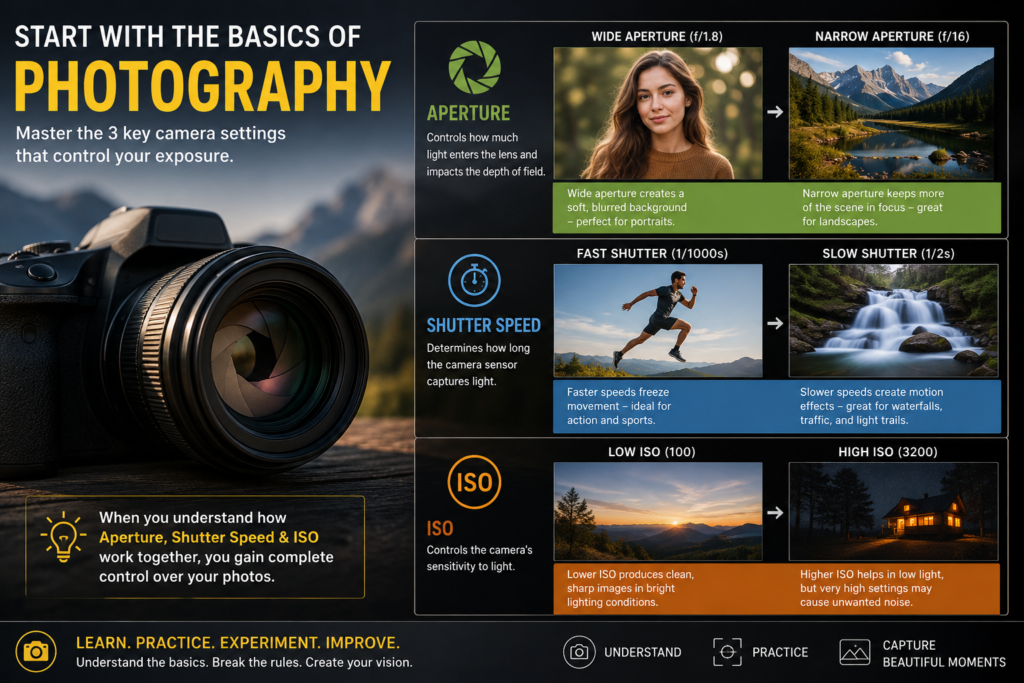
Before investing in advanced equipment, understand the fundamentals of photography. Three camera settings form the basis of exposure: aperture, shutter speed, and ISO.
Aperture controls how much light enters the lens and impacts the depth of field. A wide aperture can make a soft, blurred background that works especially well for portraits. Shutter speed determines how long the camera sensor captures light. Faster speeds are best for freezing movement, while slower speeds can create motion effects.
ISO controls the camera’s sensitivity to light. Increasing ISO can help when shooting in darker conditions, but very high settings might give rise to unwanted noise. Learning how these three settings engage will give you much greater control over your images.
Learn How Your Camera Works
Once you understand exposure, spend time becoming familiar with your camera. Whether you use a DSLR, mirrorless camera, or even a smartphone, learn where the crucial controls are located.
Practice changing aperture, shutter speed, ISO, white balance, focus modes, and exposure compensation. Try taking the same photograph applying different settings and compare the results.
You must also understand the difference among automatic, aperture priority, shutter priority, and manual modes. Automatic mode is much more comfortable, but evaluating with semi-manual and manual controls can help you contemplate why your images look different under multiple scenarios.
Practice Composition
Technical knowledge alone does not make a photograph compelling. Composition determines how visual elements are placed within the frame.
Start with simple techniques such as the rule of thirds, leading lines, symmetry, framing, and negative space. Rather than placing every subject directly in the center, consider how its position impacts the entire image.
Pay attention to interrupting objects, backgrounds, horizons, and empty areas. Before pressing the shutter button, take a moment to look around the overall frame. Minimal changes in your position or camera angle can lead to a significant difference.
.
Understand Lighting
Lighting is one of the most crucial elements of photography. Good lighting can elevate an ordinary setting into a memorable image.
Begin by observing natural light at multiple times of day. Morning and evening light usually establish softer, more attractive results, while harsh midday sunlight can create harsh shadows.
When photographing people, notice how light falls over the face. Experiment with front lighting, side lighting, and backlighting. Indoors, try using windows as natural light sources before depending on complex lighting equipment.
As you become more comfortable, discover reflectors, speedlights, and constant lights. Understanding light will let you make well-informed decisions regardless of the camera you use.
Photograph Different Subjects
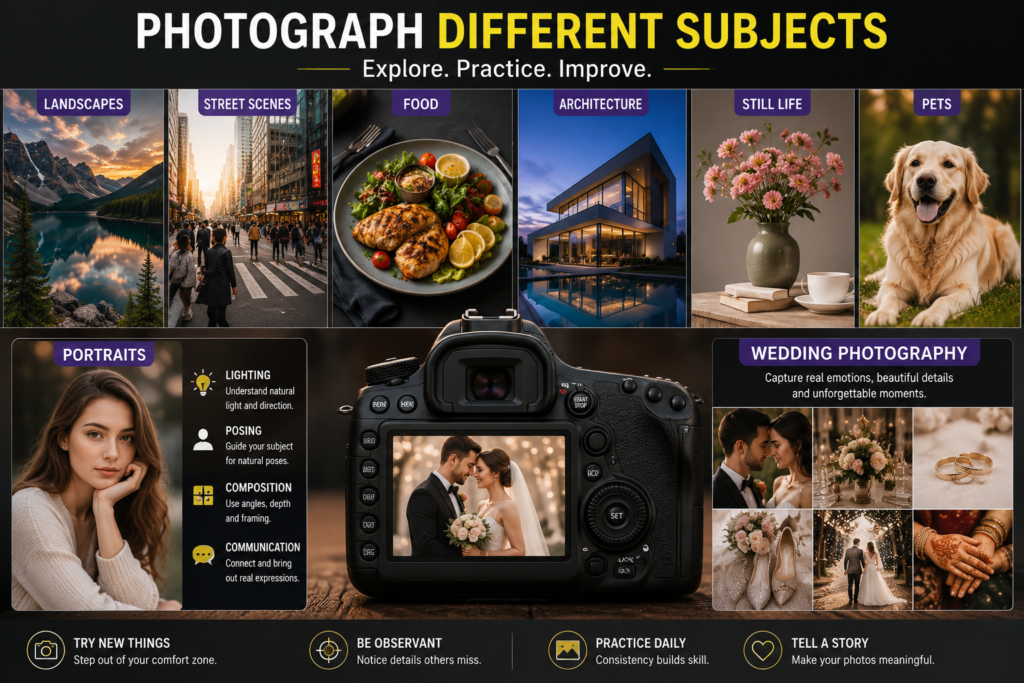
One of the perfect ways to develop your skills is to photograph a range of subjects. Try landscapes, street scenes, food, architecture, still life, pets, and portraits.
Portrait photography is particularly valuable for learning about lighting, posing, composition, and communication. If you enjoy photographing important milestones, studying professional wedding photography can also enable you to learn techniques for capturing actual emotions, details, and memorable moments.
Study Professional Photography
Looking at high-quality photography can help you build your visual judgment. Study the work of experienced photographers and ask yourself why certain images stand out.
Instead of simply deciding that a photograph appears beautiful, analyze it. Look at the lighting direction, focal length, composition, colors, background, subject placement, and emotional impact.
If you are interested in artistic photography, exploring fine art photography can also help you understand how photographers apply visual storytelling, mood, creativity, and personal perspective to communicate an idea.
You do not need to copy another photographer’s style. Rather, use professional work as inspiration while gradually building your own visual identity.
Create a Regular Photography Routine
Consistent practice is more valuable than occasional experimentation. Set yourself a simple photography challenge each week.
For example, dedicate one week to shadows, another to portraits, and allocate another to reflections. You could also challenge yourself to photograph the same subject from ten different angles.
Review your photographs afterward and recognize what worked and what did not. Ask yourself whether the subject was properly exposed, whether the composition was balanced, and whether the image communicates what you intended.
This method turns every photo session into a learning opportunity.
Learn Basic Photo Editing
Editing is another valuable skill, but it must improve your photograph rather than completely replace good camera technique.
Begin with fundamental adjustments like exposure, contrast, highlights, shadows, white balance, cropping, and sharpness. Software like Lightroom, Photoshop, or other editing applications can assist you in refining your images.
Avoid applying multiple effects at first. Natural-looking edits generally let the original subject and composition stay the focus.
As your editing skills improve, you can experiment with color grading, black-and-white conversions, creative retouching, and more advanced methods.
Choose Equipment Carefully
You do not need to buy every photography accessory when you are starting. Begin with the equipment you already have and learn its capabilities.
If you decide to upgrade, consider what type of photography you get fascinated of which most. A portrait photographer might benefit from a suitable prime lens, while someone interested in landscapes might prioritize a wide-angle lens.
A sturdy tripod can be useful for long exposures, landscapes, and low-light photography. Extra batteries and memory cards are practical additions for longer shooting sessions.
The most expensive equipment cannot replace an understanding of light, composition, timing, and storytelling.
Build Confidence Through Experience
Photography improves gradually. Your first images might not appear the way you imagined, and that is completely normal. Instead of becoming discouraged, use mistakes to recognize what you can improve.
Experiment with different perspectives, camera settings, subjects, and lighting conditions. Share selected photographs with reliable photographers or photography communities and consider constructive feedback.
Over time, you will begin to understand your capabilities and develop a personal style.
FAQs - How To Learn Photography
1. When was photography invented?
Photography was invented in the early 19th century. The first successful permanent photograph was created by Nicéphore Niépce around 1826 or 1827 using a process called heliography.
2. What is ISO in photography?
ISO controls your camera sensor’s sensitivity to light. A lower ISO generally produces cleaner images in bright conditions, while a higher ISO helps capture photos in low light but can introduce more image noise.
3. When was the first photograph taken?
The earliest known surviving permanent photograph was taken by Nicéphore Niépce around 1826 or 1827. It was created from a window of his estate in France and required a very long exposure..
4. When was color photography invented?
Experiments with color photography began in the 19th century. One of the earliest successful permanent color photographs was demonstrated by James Clerk Maxwell and Thomas Sutton in 1861. Practical color photography became more widely available during the 20th century.
5. What are some tips for getting started with photography?
Start by learning basic camera settings such as aperture, shutter speed, and ISO. Practice composition and lighting, photograph different subjects, and review your images to understand what you can improve. Most importantly, practice consistently rather than relying only on expensive equipment.
Final Thoughts
Learning photography is a continuous creative journey rather than a skill that can be mastered overnight. Start with camera fundamentals, practice composition, study lighting, photograph different subjects, and review your outcomes regularly. By the time you gain experience, introduce editing and more advanced equipment as per your goals to your goals.
The key to understanding how to learn photography is simple: practice consistently, observe carefully, experiment confidently, and learn from every click you capture. With patience and creativity, even a beginner can develop the technical skills and artistic eye required to build meaningful, professional-appearing images.
.